afpmmotor.com
1 page · 0.6s ·
Mixed signals
60% confidence
The score is a fingerprint of automation, not a quality judgment. A high score means the page reads as machine-generated. It doesn't mean the page is bad.
Headings are full-sentence, parallel constructions ("Custom work is useful only when the variables are explicit," "Start with buildable product scope instead of a generic supplier promise"), and the capability cards follow a repeated icon-title-two-sentence pattern typical of AI-assisted builders. Offsetting this, the page carries dense, specific engineering detail (Hipot, back-EMF, IP55–IP67, -40°C to +160°C, named test records) that a generic generator would rarely produce.
1 governance risk detected
- Page title
- AFPM Motor | Axial Flux Permanent Magnet Motor OEM
- Meta description
- Custom AFPM motors, dual-rotor axial flux PM motors, stator and rotor assemblies, and axial flux generator OEM support for global engineering teams.
- Final URL
- https://afpmmotor.com/
- Canonical URL
- https://afpmmotor.com/
- Robots directive
- Not set — search engines default to index, follow
- Language
- en
- Built with
- Next.js
How the page presents itself in a Google result and as a shared link, rebuilt from the tags we crawled.
AFPM Motor | Axial Flux Permanent Magnet Motor OEM
Custom AFPM motors, dual-rotor axial flux PM motors, stator and rotor assemblies, and axial flux generator OEM support for global engineering teams.
- Title · 50 characters
- Description · 148 characters
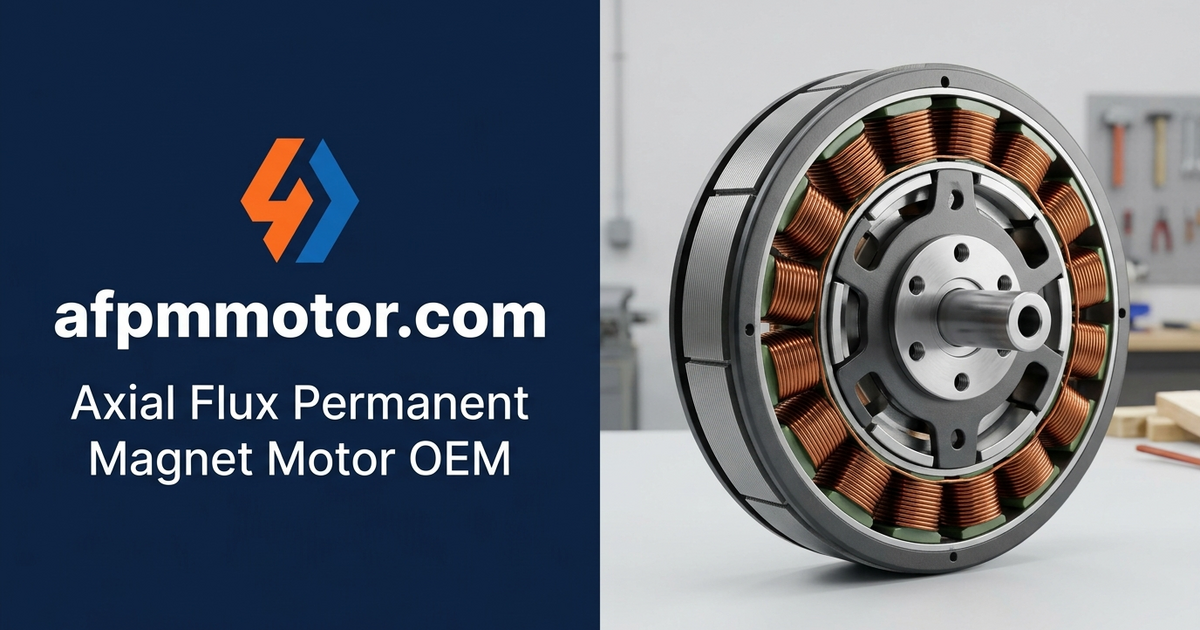
AFPM Motor | Axial Flux Permanent Magnet Motor OEM
Custom AFPM motors, dual-rotor axial flux PM motors, stator and rotor assemblies, and axial flux generator OEM support for global engineering teams.
- Open Graph image present
No AI content disclosure detected
EU AI Act Article 50 requires that AI-generated content presented to EU audiences be labelled as such. The FTC has also signalled enforcement interest in undisclosed AI-generated content. A simple site-wide disclosure policy covers both.
## AI Content Policy

Some content on this website is created or assisted by artificial intelligence
(AI) tools. We are transparent about our use of AI and committed to accuracy.

**What we use AI for:** [content drafting / image generation / data summaries]
**Human review:** All AI-generated content is reviewed before publication
**Accuracy:** We verify factual claims, but AI-generated content may contain errors

This disclosure is consistent with EU AI Act Article 50 obligations.

Questions? Contact us at [email].

_Policy version: 1.0 — [DATE]_
<!-- Place in your site header or footer -->
<div
  class="ai-disclosure-notice"
  role="note"
  aria-label="AI content notice"
>
  Some content on this site is AI-assisted.
  <a href="/ai-policy">Our AI policy</a>
</div>
- Clear signalStructure
Capability cards and headings follow a uniform template with parallel full-sentence H2s
Evidence- “Quality Gates, Not Slogans”body
- “Custom work is useful only when the variables are explicit.”H2
- “Prototype to Volume Path”body
Try thisVary heading length and form, and replace some full-sentence H2s with short labels that name the actual product or process.
- Clear signalContent
Marketing phrasing is generic in places while technical specifics are strong
Evidence- “Start with buildable product scope instead of a generic supplier promise.”body
- “Send the parameters that change design, cost, and lead time.”H2
Try thisCut contrast-framing lines like 'instead of a generic promise' and state concrete outcomes, such as a named customer result or a real sample lead time.
Signals of human authorship the page is doing well.
- Content
Specific engineering detail: named test procedures, IP ratings, temperature range, and a 4-8 week sample window.
- Content66
Parallel "X, Not Y" and "instead of" framing across headings like "Quality Gates, Not Slogans" reads as templated B2B copy
- Structure72
Hero, then 4-card capability grid, stats row, then Q&A-style sections; a common AI site-builder layout
- Imagery35
18 images with full alt coverage and no visible AI filenames; the imagery signal is weak and not conclusive
- Tone58
Uniform, polished register throughout with no author voice, though specific technical detail offsets the generic marketing tone
- Words1,285
- Images18
- Alt coverage100%
- Internal links55
- External links4
- Schema blocks2
- HTML size297 KB
- Text-to-HTML3%
No common LLM-marker phrases found — none of the stock AI vocabulary we scan for appears in the body text even once.
- Meta tagsAll presentWhy this matters
Why it matters. Title and description are the two strings Google shows in search results. They decide whether anyone clicks. A canonical tag tells Google which URL is the source of truth when the same content lives at multiple paths.
Passing looks like. A non-empty title under 60 characters, a meta description under 160, and a self-referencing canonical link.
Fix. Add the missing tags inside the page head. Treat the title as a headline you'd want to read in a SERP, not a brand slogan.
- Heading structure1 H1, 11 H2Why this matters
Why it matters. Headings are how crawlers and assistive tech understand a page's outline. One H1 names the page. H2s break it into sections. Skipped levels and missing H1s confuse both.
Passing looks like. Exactly one H1, at least one H2, and no skipped levels (no H1 to H3 jumps).
Fix. Replace the missing or duplicate H1 with a single, descriptive heading. Promote section titles to H2. Demote sub-points to H3.
- Mobile readinessResponsiveWhy this matters
Why it matters. Google indexes mobile-first. A page without a responsive viewport renders zoomed-out on phones, fails Core Web Vitals on touch, and loses its mobile ranking.
Passing looks like. A meta viewport tag with width=device-width and a layout that reflows under 600px.
Fix. Add a viewport meta tag set to width=device-width and initial-scale=1, then audit your largest blocks at mobile widths.
- Page speed signals0.6s · 297 KBWhy this matters
Why it matters. Page weight and response time directly feed Core Web Vitals. Slow LCP and oversized HTML hurt rankings more than people expect.
Passing looks like. First-byte under 1.5s, HTML payload under 500 KB, fewer than 30 images on the initial render.
Fix. Trim render-blocking scripts, defer non-critical CSS, and serve compressed images sized to the viewport. Move heavy components below the fold.
- Schema markup2 schema blocksWhy this matters
Why it matters. JSON-LD structured data is how you earn rich results: review stars, FAQ accordions, breadcrumbs, article cards. Skip it and Google has nothing structured to pull from when it builds your SERP card.
Passing looks like. At least one valid JSON-LD block matching schema.org types relevant to the page (Article, Product, FAQPage, Organization).
Fix. Add an application/ld+json script block describing the page. Validate with Google's Rich Results Test before deploying.
- Broken links0/5 broken in sampleWhy this matters
Why it matters. Broken internal links waste crawl budget, degrade UX, and signal to Google that the site isn't well-maintained. They also cap how deep crawlers reach.
Passing looks like. Every internal link in the sample returns 2xx or 3xx. No dead anchors, no stale paths.
Fix. Use the link list above to spot the broken paths. Either restore the missing pages or update the links to point at live URLs.
- Image alt textAll have altWhy this matters
Why it matters. Alt text is what screen readers read aloud, and what Google reads instead of pixels. Skip it and you lose on both fronts.
Passing looks like. Every meaningful image has a descriptive alt attribute. Decorative images can use alt="" to be skipped intentionally.
Fix. Audit images in /assets and CMS uploads. Write alts that describe what's in the image, not what it links to.
Every H1, H2, and H3 we found on the page, in document order.
Show heading outline
- H1AFPM Motor Supply for Compact High-Torque Programs
- H2What You Can Qualify Before RFQ
- H2Timeline and Control Points Buyers Ask About
- H2Start with the AFPM supply form your project actually needs.
- H2Custom work is useful only when the variables are explicit.
- H2Evidence buyers should ask for before shipment.
- H2A practical route from first email to recurring supply.
- H2Match the motor conversation to the real operating duty.
- H2Latest Engineering Guides
- H2Send the parameters that change design, cost, and lead time.
- H2Technical & Sourcing Clarifications
- H2Send the AFPM Parameters That Matter
- H3Motor / Generator Builds
- H3Package & Interface Control
- H3Thermal & Duty Review
- H3Traceable Test Plan
- H3Product Capability First
- H3Custom Scope With Inputs
- H3Quality Gates, Not Slogans
- H3Prototype to Volume Path
- H3Axial Flux Permanent Magnet Motors
- H3AFPM Stator and Rotor Assemblies
- H3Dual-Rotor AFPM Motors
- H3AFPM Generators
- H3Before sample build
- H3Prototype release
- H3Pilot lot
- H3Volume supply
- H3RFQ intake
- H3Feasibility and quotation scope
- H3Prototype sample
- H3Pilot to production
- H3Electric Motorcycle and Light EV Drives
- H3Robotics Compact Joint Drives
- H3Drone and eVTOL Propulsion
- H3Renewable Direct-Drive Generators
- H3Foxconn & Magnax €35.5M Investment: Industrializing Yokeless Axial Flux Motors
- H3Scaling Axial Flux Motors in 2026: How the EU MAXIMA Project Addresses Manufacturing and CRM Constraints
- H3Specifying Axial Flux Motors for 800V Architectures: Insulation & PD Risks
- H3What parameters do you need for a preliminary sizing check?
- H3Do you provide dyno test reports with prototype batches?
- H3Can we procure only the stator/rotor active parts?
- H3Is coreless AFPM better than iron-core AFPM?
- H3What affects lead time for a customized prototype?
We HEAD-check up to five internal links to spot broken paths quickly.
Show sampled links
Was this report useful?
Share this scan
Every CrawlRanker scan gets a public, shareable URL. Send it to a client, post it in a thread, or benchmark a competitor.
Preview scan. SEO checks are live. AI scoring is in beta.